Issue Description
In Cambodia, businesses operating in regulated sectors must obtain specific sectoral licenses in addition to completing their general business registration on the Online Business Registration (OBR) portal. While the OBR centralises company registration across the Ministry of Commerce, the Ministry of Labour, and the General Department of Taxation of MoEF, sectoral licenses remain outside this system and continue to be processed both digitally and manually by line ministries or local authorities.
The OBR provides a strong foundation for business operations and offers a significant opportunity for data sharing with line ministries for sectoral licenses and permits. Currently, companies often resubmit physical or soft copies of documents that already exist digitally on the IPM or OBR, sometimes with official QR-code verification. Despite this, ministries still require paper-based submissions, in-person visits, or duplicate soft copies issued by other ministries. This lack of digital integration creates duplication, longer processing times, and inconsistent service standards. In the logistics sector, multiple ministries govern different aspects of operations, increasing duplication and inefficiency for businesses seeking compliance with Cambodian law.
Overview of the existing and proposed licenses that may apply to companies in the transport and logistics sector.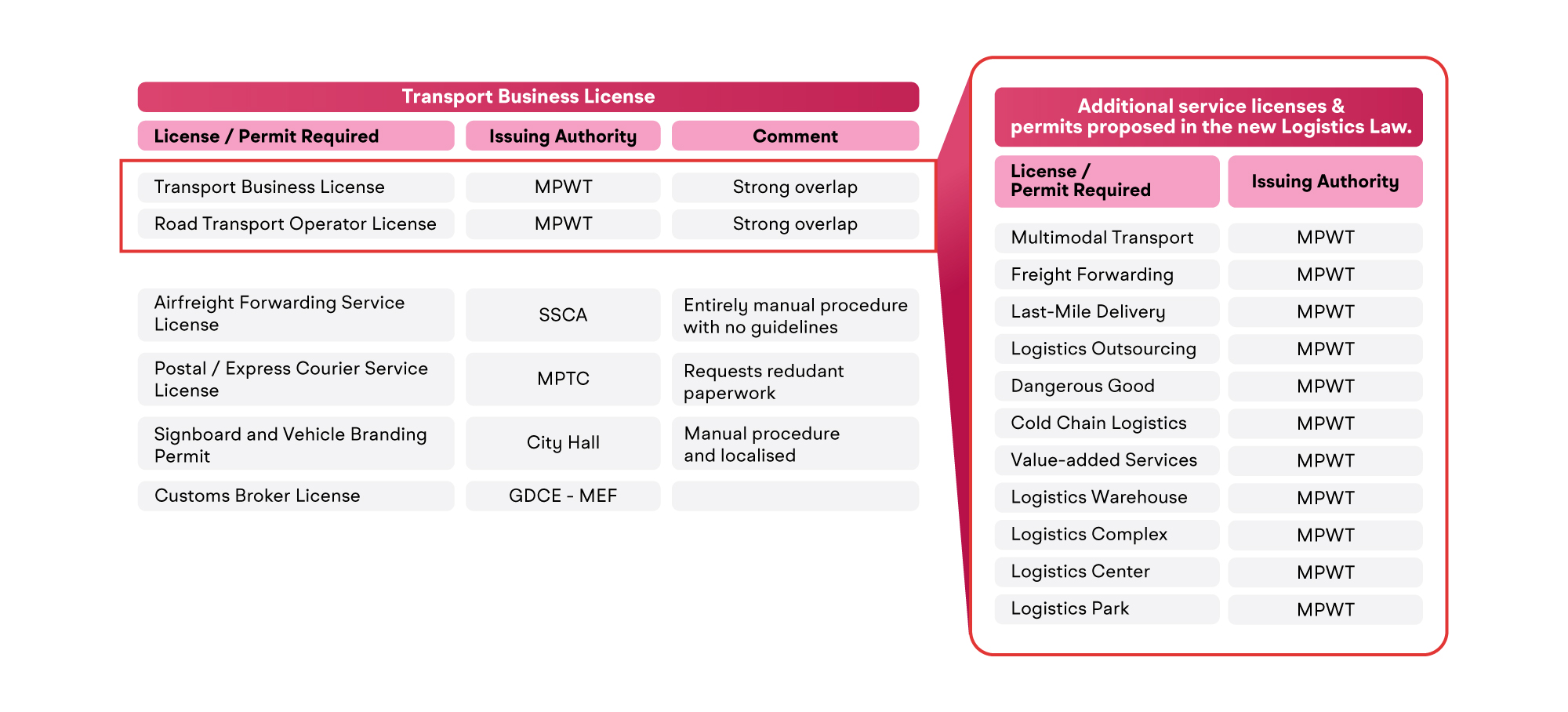
These are a few examples of licensing requirements for the logistics sector:
- Postal and express operators must submit applications directly to MPTC, including corporate registration documents. As shown in the figure above, much of this information duplicates what firms already provide to MPWT and what is stored on the OBR.
- Signboard and vehicle branding permits are issued manually by municipal authorities such as City Hall. Procedures vary by location and are not integrated into national digital systems.
- MPWT issues transport business licenses through its own portal rather than through the OBR. Although some steps are online, companies may still be required to submit hard-copy documents and collect permits in person. Because the MPWT system is not integrated with OBR data, the same documents must be repeatedly submitted and manually verified.
- SSCA issues airfreight forwarding licenses entirely manually, with no published guidelines and no functional online application system. Applicants must obtain requirements directly from SSCA offices, contributing to inconsistent expectations and procedures.
Impact on business
This licensing framework highlights five generic business documents that are redundantly requested from companies, even though soft-copies could be retrieved directly from OBR servers. There is also an opportunity to reduce the number of documents required, as a corporate governance organisational chart is requested, which appears unclear and potentially unrelated to postal or express activities.
Moreover, because the definitions of express delivery and logistics services overlap, firms often submit nearly identical documents through two separate licensing processes, increasing compliance costs, and causing inconsistent processing timelines. Logistics companies must apply for multiple permits each year using duplicated forms and document sets.
The parallel operation of separate licensing systems creates repetitive submissions, as there is limited data sharing between ministries, with manual approvals and inconsistent processing times remaining common. Businesses must also submit documents in hard copy, often through multiple rounds of back-and-forth communication. The absence of digital submission and standardised forms increases processing time, compliance costs, and administrative workload for both businesses and government.
Joint Effort to Reduce Red Tape
- Reviewing with the Council for the Development of Cambodia the sectoral licences
- Providing input to the Ministry of Public Works and Transport to reduce overlapping licenses and permits across ministries
- Advocating for one Single Logistics License model that integrates all components
Benefits of Reform:
Streamlining sectoral licensing, particularly through digital integration with the OBR, would significantly reduce administrative burdens, shorten processing times, and improve predictability for businesses.
Over time, overlapping licensing requirements across SSCA, MPWT, and MPTC should be harmonised, either through a merged logistics license or by consolidating common documentation, to reduce the number of separate permits required for similar activities.
Ministries would benefit from reduced manual verification, fewer duplicated document checks, and more consistent data use. For the logistics sector, where operators must interact with multiple ministries, harmonising and digitising procedures would lower costs, support faster market entry, and strengthen Cambodia’s appeal as a competitive regional logistics hub.