
Issue Description
Qualified Investment Projects (QIP) are a key factor of Cambodia’s attractiveness for foreign companies and play a vital role in drawing long-term investment into the country. While QIP registration can now be completed through the CDC’s Investment Project Management (IPM), with documentation uploaded digitally, companies must still complete the regular business registration process on the Online Business Registration Portal (OBR). The OBR is used by three core institutions: the Ministry of Commerce (MoC), the Ministry of Labour and Vocational Training (MoLVT), and the General Department of Taxation (GDT). There is currently document duplication and a lack of soft-copy validation and data sharing between IPM and the OBR, with many documents required to be submitted for both processes.
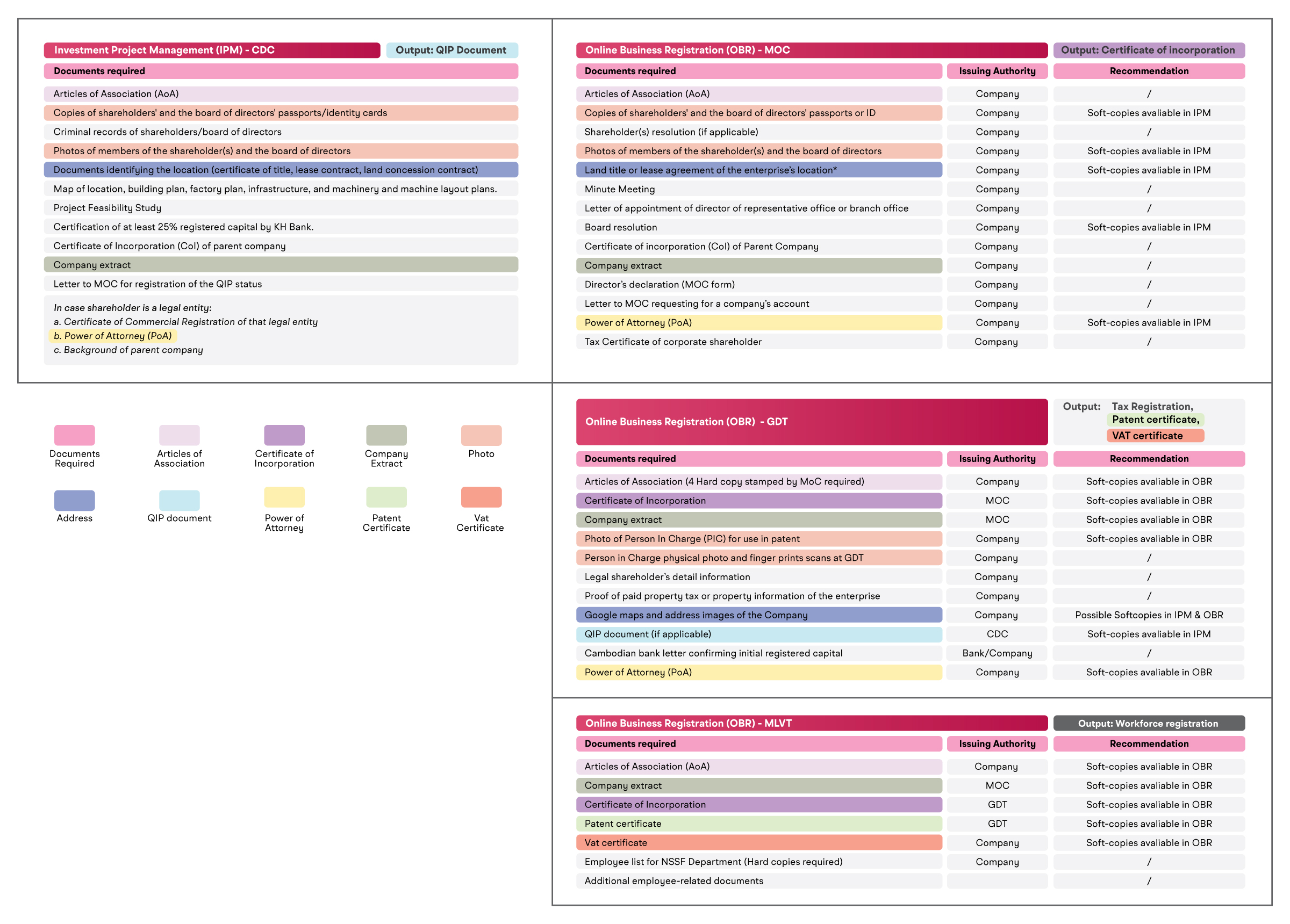
The table below has identified the documents requested, with 59% of business documents being re-requested at later stages of incorporation, thus the image below highlights information sharing opportunities between the above-mentioned ministries of the Royal Government of Cambodia.
Impact on business
The presence of document duplication and the lack of soft-copy validation and sharing between IPM and OBR slow down the registration process, disproportionately affecting foreign companies, which often need third-party agencies to complete registration. While CAMDX was created for inter-agency data verification, CDC does not currently have back-end access to the OBR, and vice versa, limiting the ability to leverage publicly shared patent and tax data. Enabling secure back-end access between the two systems would significantly reduce the time required to register a business.
Moreover, because soft-copy validation is not recognized across all ministries, documents issued by MoC in both soft and hard copy often still need to be physically submitted to MoLVT and GDT. This not only slows registration timelines but also increases costs, workload, and the risk of data inconsistencies across government systems. Finally, redundant administrative steps persist despite the availability of digital platforms, preventing companies from fully benefiting from the IPM and OBR’s online features. Duplicative document requirements, such as submitting the same soft-copy files or photographs multiple times, further exacerbate these delays and hinder companies’ ability to start operations efficiently.
Joint Effort to Reduce Red Tape
- Reviewing and remove redundant document requirements, such as requesting separate photographs in addition to passports/National IDs, which already include standardized photos.
- Exploring how to strengthen soft-copy validation and document sharing between CDC’s IPM and the ministries on the OBR, providing back-end access for line ministries on their portals for soft-copy document validation on the government side.
Benefits of Reform:
These measures would reduce the total processing time for business registration and QIP approval, promote digital government by strengthening integration, transparency, and trust in online public services, improve data consistency across MoC, MLVT, GDT, and CDC systems through shared digital records, and lower administrative costs for government institutions.