

Issue Description
With recent disruptions in global trade and the renewed use of tariffs, coupled with Cambodia’s graduation from Least Developed Country (LDC) status in 2029 and the transition ending in 2032, efficient trade procedures have become critical to remain a competitive trading nation.
The Certificate of Origin (CO) certifies that export goods are wholly obtained, produced, or substantially transformed in Cambodia, enabling preferential tariff access. While official processing is 1–2 days, in practice it can take up to 7, causing costly delays and supply chain disruptions, especially around Sihanoukville Autonomous Port. Costs for the Certificate of Origin in Cambodia are also higher than in neighboring countries, reducing competitiveness.
Although the Ministry of Commerce (MoC) offers an online portal for applications and electronic payments, manual steps, including cash payments and hard-copy invoice submissions remain. Applications are still handled case by case, limiting digital system benefits. These inefficiencies increase lead times and costs for garment and other export industries. As Cambodia graduates from LDC status and stricter Rules of Origin (ROO) apply, modernising the CO process is critical to ensure timely access to preferential tariffs.
Impact on business
The competitiveness of Cambodian exporters is being challenged due to the long paperwork process and the high cost associated with this government service. EuroCham members in the garment sector speak of unrealistic order lead times, while non-garment sectors report losing orders due to delayed fulfillment of deliveries.
The current Certificate of Origin procedure can be illustrated as follows: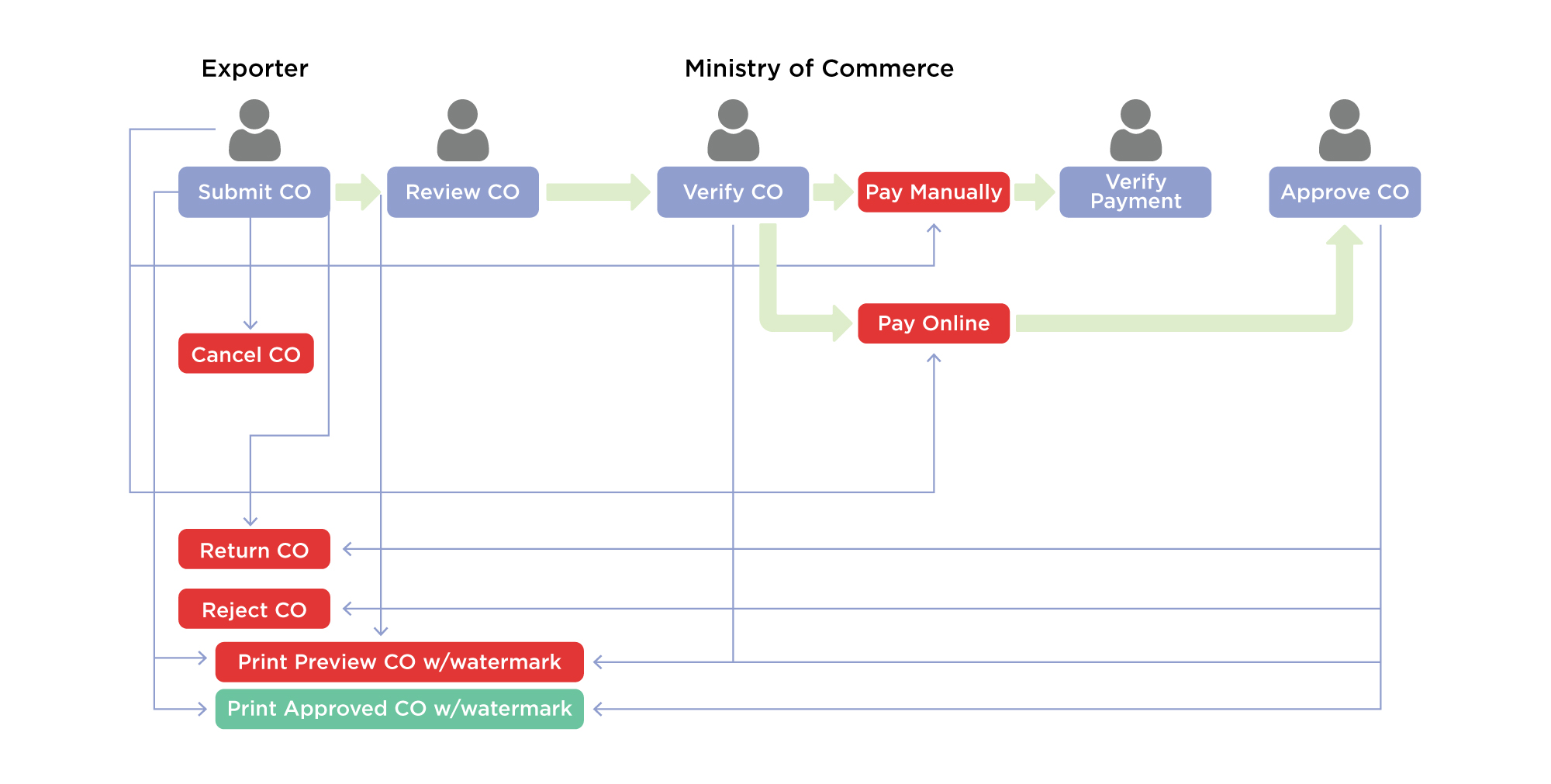
Red Tape procedure
The first core problem is that the Ministry of Commerce still allows manual cash payments, which require separate verification and create an extra step in the application process.
The second is that hard-copy invoices are still required, even though other documents can be submitted digitally. Exporters using third-party agencies must physically deliver invoices both to the service provider and to the Ministry, adding further delays and costs.
These procedural redundancies mean that Ministry staff first process paper documents and then enter the same information into digital systems, duplicating work and increasing administrative burden. Maintaining human resources on manual payment verification and paper handling may not represent the most efficient use of available administrative capacity, particularly when digital systems could process a higher volume of applications.
As a result, lead times are longer, compliance costs are higher, and predictability for exporters is reduced. These inefficiencies affect both businesses and government and will become even more critical once Cambodia graduates from LDC status and stricter Rules of Origin apply.
Joint Effort to Reduce Red Tape
- Exploring how digital payments can be offered through all Financial Service Providers in Cambodia so the manual payment option in the Certificate of Origin process can be removed
- Identifying which legislation still requires hardcopy archiving, preventing the use of only the digital invoice of goods for which the Certificate of Origin is to be issued
Benefits of Reform:
By implementing these reforms, the CO process becomes faster, more automated, and more efficient, enabling exporters to meet lead times, lowering compliance costs, and fully leveraging digital systems. Ministry staff can handle more applications per day, data consistency is improved, and resources are freed for other trade facilitation activities.