Issue Description
As Cambodia and its capital Phnom Penh continue to develop rapidly, the country has the potential to attract a growing segment of the business tourism industry focused on organizing and hosting large-scale professional events such as networking forums, conferences, and exhibitions. This sector, commonly referred to as “Meetings, Incentives, Conferences and Exhibitions” (MICE), represents an important source of revenue for event venues, hotels, and the wider hospitality industry.
However, under the current regulatory framework defined by Prakas No. 075 on the Preparation, Organization and Management of Trade Fair Events in the Kingdom of Cambodia issued by the Ministry of Commerce, a wide range of events are broadly categorized as commercial exhibitions. The regulation specifies that “all arrangements for trade fairs, product displays, and product or service promotions of any kind for the purpose of advertising, selling, seeking partners to make profits, or distributing products or services for market circulation are considered trade fair events, even when the theme is general, profession-focused, or market-centred.” As a result, most business events may fall under the same regulatory category as commercial trade fairs, significantly expanding the scope of events required to obtain a permit.
In practice, limited distinction is made between different types of events, such as open or closed-door formats, public or private venues, or events involving direct sales versus purely informational or networking activities. Consequently, a wide range of events (including those organized by private companies, chambers of commerce, NGOs, development partners, embassies, and government organizations) may be required to obtain a Commercial Exhibition Permit from the Ministry of Commerce. However, organizers must submit an application at least 45 days prior to the event date, or face uncertainty around if the event is able to be held at all.
The applicable fees are defined under Prakas No. 315 of the Ministry of Economy and Finance, which sets the following charges:
- Permit fee: 1,400,000 riels (approximately US$350)
- Fee per Booth: 100,000 riels (approximately US$25), with agricultural events having a reduced booth fee of 20,000 riels (approximately US$5)
While these regulations aim to provide oversight for commercial trade fairs, the current scope of application creates uncertainty for organizers of business events that may not involve commercial sales activities.
Impact on business
Unclear definitions regarding the boundary between sales-driven exhibitions and non-commercial business events create uncertainty for organizers, who cannot reliably determine when a permit is required.
EuroCham recommends introducing clearer guidance to determine when a Commercial Exhibition Permit is required. This could be achieved by distinguishing events based on three key factors:
- Location: whether the event takes place in a public venue or a private venue;
- Access: whether the event is open to the public or closed-door (invitation-only);
- Purpose of the activity: whether the event involves direct commercial sales, or is limited to promotion, networking, or the presentation of products and services without direct sales.
A clearer interpretation of these conditions would help businesses and event organizers understand in practical terms when the permit requirement should apply. Under the current regulatory framework, the scope of the licensingpermit requirement may extend broadly across many different types of events, regardless of whether they involve direct commercial sales, whether participation is open to the public, or whether the event takes place in a public or private venue.
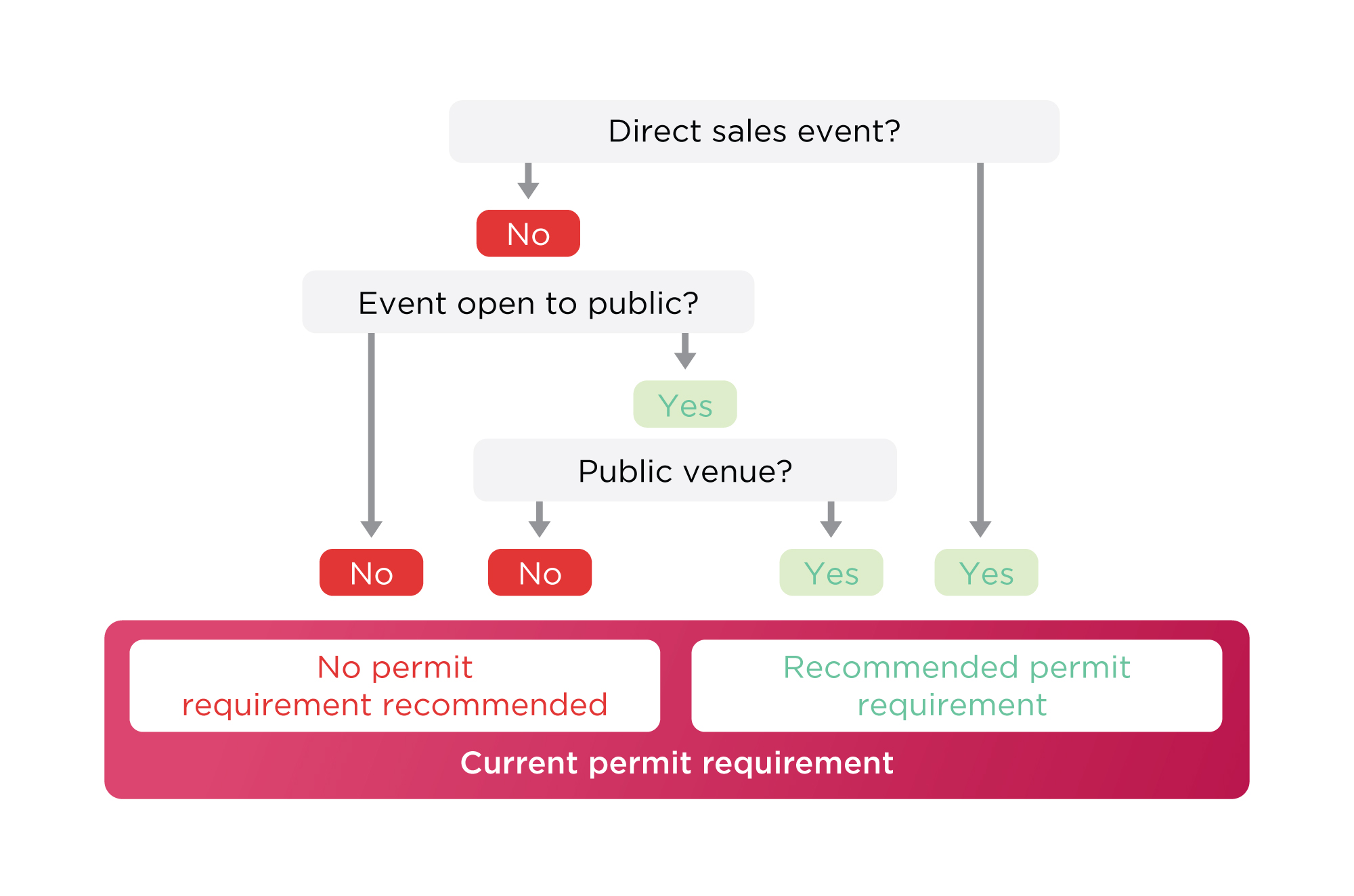
The diagram above illustrates how these three criteria (direct sales activity, event accessibility, and venue type) could be used to more transparently distinguish and determine the applicability of the Commercial Exhibition Permit.
The broad regulatory scope also means that events unrelated to commercial sales, such as CSR seminars, academic conferences, or closed-door networking sessions, may fall within the same permit framework as commercial trade fairs. In practice, this may bring purely informational or professional exchange activities into a regulatory regime designed primarily for commercial exhibitions. As a result, non-profit organizations, chambers of commerce, and development partners that organize knowledge-sharing or policy dialogue events may face the same requirements and fees despite not engaging in commercial sales activities.
As approval is not guaranteed when applying for a permit, organizers face financial risks related to venue deposits, marketing expenses, sponsorship agreements, and international speaker commitments. This uncertainty discourages investment in Cambodia’s events sector.
The additional financial costs for exhibitors and participants may also discourage participation, particularly for international businesses unfamiliar with Cambodia’s regulatory environment. Such costs may be perceived as part of the broader cost of doing business in the country, potentially affecting Cambodia’s competitiveness as a destination for professional events.
Overall, the current permit framework may reduce the attractiveness of Cambodia as a destination for business tourism and professional events, particularly when the permit provides no facilitation services beyond authorization.
Red Tape procedure
The current application process provides little flexibility to business event organisers with a 45-days approval process in a sector that requires adaptability and involves several administrative steps that remain largely manual and paper-based.
Applicants must submit formal letters and supporting documentation, often combined with informal communications and repeated verification procedures, despite the availability of digital administrative tools. This process creates a high administrative burden for both businesses and government authorities. Officials must manually review documentation, verify participant lists, and approve manual invoices, increasing workload and the potential for procedural inconsistencies. Any changes to title, date or time or overall characterization require a new formal letter to the Ministry.
In some cases, the procedure may become more complex when the event relates to sectors regulated by line ministries, such as agriculture or health. Organizers may then face duplicated authorization procedures, extending approval timelines and increasing administrative uncertainty.
Additionally, the absence of clear written guidance or an online application system forces many organizers to rely on informal clarification or legal consultation to understand the requirements.
Joint Effort to Reduce Red Tape
Clarification in Prakas No. 075 about permit requirements:
- Clarify the distinction between commercial trade fairs involving product sales and non-commercial business events such as conferences, policy dialogues, or networking forums. Provide clearer written guidance on which types of events require a Commercial Exhibition Permit under Prakas No. 075.
- Review how Prakas No. 075 can reduce the burden on the MICE sector to ease the organisation of business tourism events in Cambodia.
Digitalisation and simplification of procedures:
- Introduce a digital application platform for event permits to reduce paperwork and processing times for private sector and save public sector human resources.
- To facilitate understanding for international organizers and businesses, an English translation of the relevant regulatory provisions could be made available on the Ministry of Commerce website, helping clarify the applicability of the regulation and the conditions under which event permits are required.
Benefits of Reform:
Clearer categorization of event types would greatly improve regulatory transparency, enabling organizers and business partners to more easily determine whether a permit is required. This would significantly enhance planning certainty, strengthen compliance with existing regulations, and reduce the risk of misunderstandings or unintentional non-compliance.
Moreover, simplifying and digitalizing the application process would substantially reduce administrative costs and processing times for both businesses and authorities, making it easier and more attractive for organizers to formally register events through the Ministry of Commerce.
A more facilitative and transparent regulatory environment would support the continued growth of Cambodia’s business tourism industry, benefiting the hospitality sector, event venues, and the wider service economy. In the longer term, these improvements would help strengthen the competitiveness of Cambodia’s MICE sector, encouraging increased investment in conferences, exhibitions, and professional networking events in Phnom Penh and across the country.